
New Migrant Return Policy Index reveals major human rights gaps in European return policies
Brussels, 6 March 2026 – A new comparative report launched today by the Migration Policy Group (MPG) finds that return policies across Europe remain far from fully aligned with human rights standards, at a time when return has become a central political priority across the EU.
As the European Parliament prepares to vote next Monday on the new EU Return Regulation, the launch of the Migration Return Policy Index (MIREX) comes at a decisive moment for Europe’s return policy framework. The upcoming vote represents a turning point for the Parliament to reaffirm that human rights remain a foundational principle of EU migration policy and are not sidelined in the pursuit of enforcement objectives.
Developed by MPG under the EU-funded Finding Agreement in Return (FAiR) project, MIREX provides a comparative, evidence-based assessment of return policies across 11 European countries. The index evaluates whether national laws ensure that returns are safe, dignified and sustainable, and offers a data-driven foundation to inform legislative debates at EU level.
The findings show that the current return landscape across Europe is not only fragmented, but often structurally imbalanced, with coercive tools prioritised over rights protection, dignity and legitimacy. If EU return policy is to be credible, effective and fully aligned with fundamental rights obligations, a recalibration is necessary.
Key findings
Across the 11 countries assessed, MIREX identifies three overarching trends:
- Significant heterogeneity in national return policies, with many countries relying heavily on detention and enforcement-driven measures.
- Limited assistance available to returnees, alongside notable gaps in fundamental rights safeguards.
- Very limited use of alternatives to detention and few accessible or sustainable regularisation pathways.
More detailed findings include:
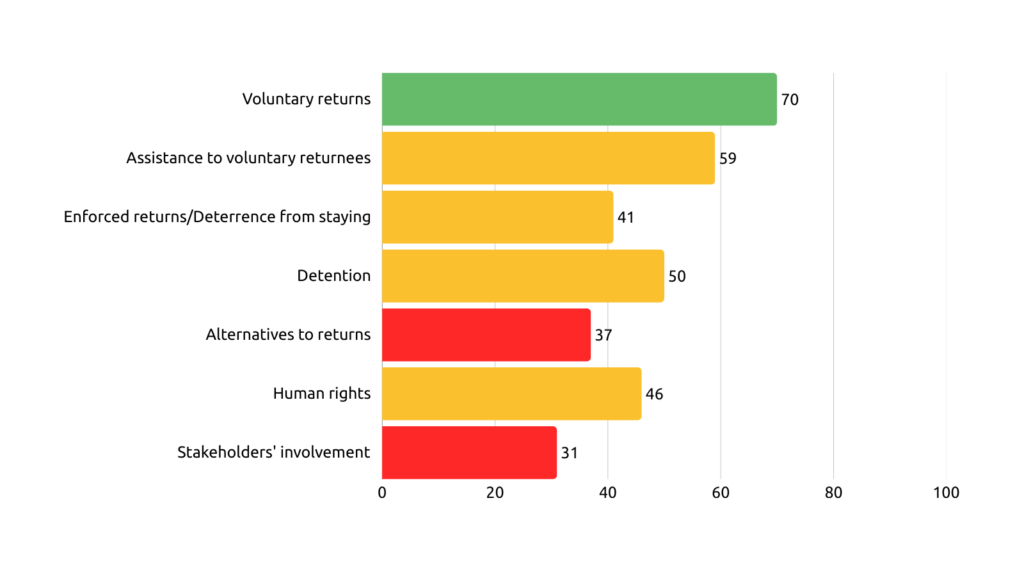
- Voluntary return policies score an average of 70 out of 100. Most countries provide structured procedures and broad eligibility criteria on paper, but short deadlines for voluntary departures make true choice harder.
- Assistance to voluntary returnees scores 58 out of 100, reflecting gaps in reintegration support and limited targeted programmes for vulnerable groups.
- Detention policies average 50 out of 100, with wide variation between countries. Several countries allow long or extendable detention periods and broad grounds for detention, while humane alternatives to detention remain scarce.
- Human rights safeguards score 46 out of 100, revealing systemic gaps, including the detention of children and limited independent monitoring.
- Enforced return policies average 41 out of 100, highlighting continued reliance on punitive and restrictive measures towards undocumented migrants.
- Alternatives to return, including regularisation mechanisms, score only 37 out of 100 overall, reflecting the absence of accessible legal pathways for migrants to regularise their status and fully participate in society.
- Stakeholder involvement is the weakest dimension, with an average score of 31 out of 100. Civil society, migrant organisations and countries of return are largely excluded from policymaking, implementation and monitoring.
A rights-based benchmark
MIREX is grounded in international and European legal standards, including the EU Charter of Fundamental Rights, the European Convention on Human Rights and the Return Directive. The index is based on 53 indicators assessed by national experts and reviewed through a structured validation process.
MIREX uses a 0–100 scoring system to evaluate how well national return policies comply with human rights standards. Lower scores indicate greater gaps and a stronger need for policy reform to address deficiencies. Rather than ranking countries with a single overall score, MIREX presents separate scores for each policy dimension to allow for a nuanced and evidence-based comparison.
The report covers Austria, France, Germany, Greece, Italy, the Netherlands, Spain, Sweden, Switzerland, the United Kingdom and Poland.
Policy recommendations to the European Parliament
In light of the forthcoming EU Return Regulation, MPG calls on the European Parliament to ensure that the future framework strengthens effectiveness while fully respecting fundamental rights.
Based on MIREX findings, key recommendations include:
- Stronger support for assisted voluntary return and sustainable reintegration frameworks.
- The establishment of firewalls to guarantee undocumented migrants access to basic services without fear of immigration enforcement.
- The expansion of humane and effective alternatives to detention.
- The development of accessible regularisation pathways to provide migrants secure status and opportunities for full participation in society.
- More meaningful stakeholder involvement throughout the policy cycle, ensuring transparency, accountability and evidence-based policymaking.
As implementation of the EU Pact on Migration and Asylum and the adoption of the new Return Regulation move forward, improving return rates must not come at the expense of fundamental rights.
At a time when legislative choices will shape return governance for years to come, MIREX offers an independent and data-driven basis to move the debate beyond rhetoric and towards return policies that are both effective and rights-compliant.
Publication
Authors

Carmine Conte
Senior Legal Policy Analist

Marianna Gorgerino
Former Research Intern
About the Migration Policy Group (MPG)
MPG is an independent think-and-do-tank based in Brussels. MPG’s purpose is rooted in its ability to inspire networks to provide evidence-based projects, research and campaigns in the areas of integration, migration and anti-discrimination.