Strengthening migrant entrepreneurship: towards more coordinated, inclusive support ecosystems
Migrant entrepreneurship plays an increasingly important role in driving innovation, job creation, and social inclusion across Europe. However, despite this contribution, many migrant entrepreneurs continue to face systemic barriers that limit their ability to start and grow businesses.
A new series of policy briefs developed under the INNOVATE The Migration to Research Policy Co-Lab project and written by MPG’s Olivia Long and Mojib Attal, examines these challenges and identifies key areas for policy action. The findings point to a central conclusion: support for migrant entrepreneurship remains fragmented and requires stronger coordination, improved access to finance, and more effective communication.
Fragmented systems, shared challenges
Support for migrant entrepreneurs is delivered across multiple actors and levels of governance, including public authorities, financial institutions, civil society organisations, and private sector stakeholders.
While this diversity reflects a rich ecosystem, it also creates fragmentation. Responsibilities are often dispersed, policies are not always aligned, and services can be difficult to access or navigate.
As highlighted in the coordination brief, this fragmentation can result in overlapping mandates, gaps in accountability, and reduced policy effectiveness.
Strengthening coordination across actors and levels
 The first policy brief focuses on coordination as a key enabler of effective entrepreneurship ecosystems.
It finds that coordination remains underdeveloped in many contexts, despite its importance for aligning responsibilities, improving policy coherence, and connecting services.
The brief identifies several priorities for policymakers:
- clarifying roles and responsibilities across institutions
- establishing long-term coordination mechanisms
- strengthening collaboration between public, private, and civil society actors
Effective coordination, whether horizontal, vertical, or external, is essential to reduce fragmentation and ensure that support systems operate coherently.
Improving access to finance
 The second brief examines persistent barriers to accessing finance.
Migrant entrepreneurs often face structural and institutional challenges, including limited credit history, lack of collateral, regulatory complexity, and limited familiarity with financial systems. These barriers are particularly pronounced for women, refugees, and newly arrived migrants.
The brief also highlights the growing role of alternative financing mechanisms, such as:
- microfinance and guarantee schemes
- crowdfunding and peer-to-peer lending
- diaspora investment
- Islamic finance models
While these approaches show promising results, they remain insufficiently integrated into mainstream financial systems. Strengthening their institutional support and scalability is a key policy priority.
Enhancing communication for inclusive support
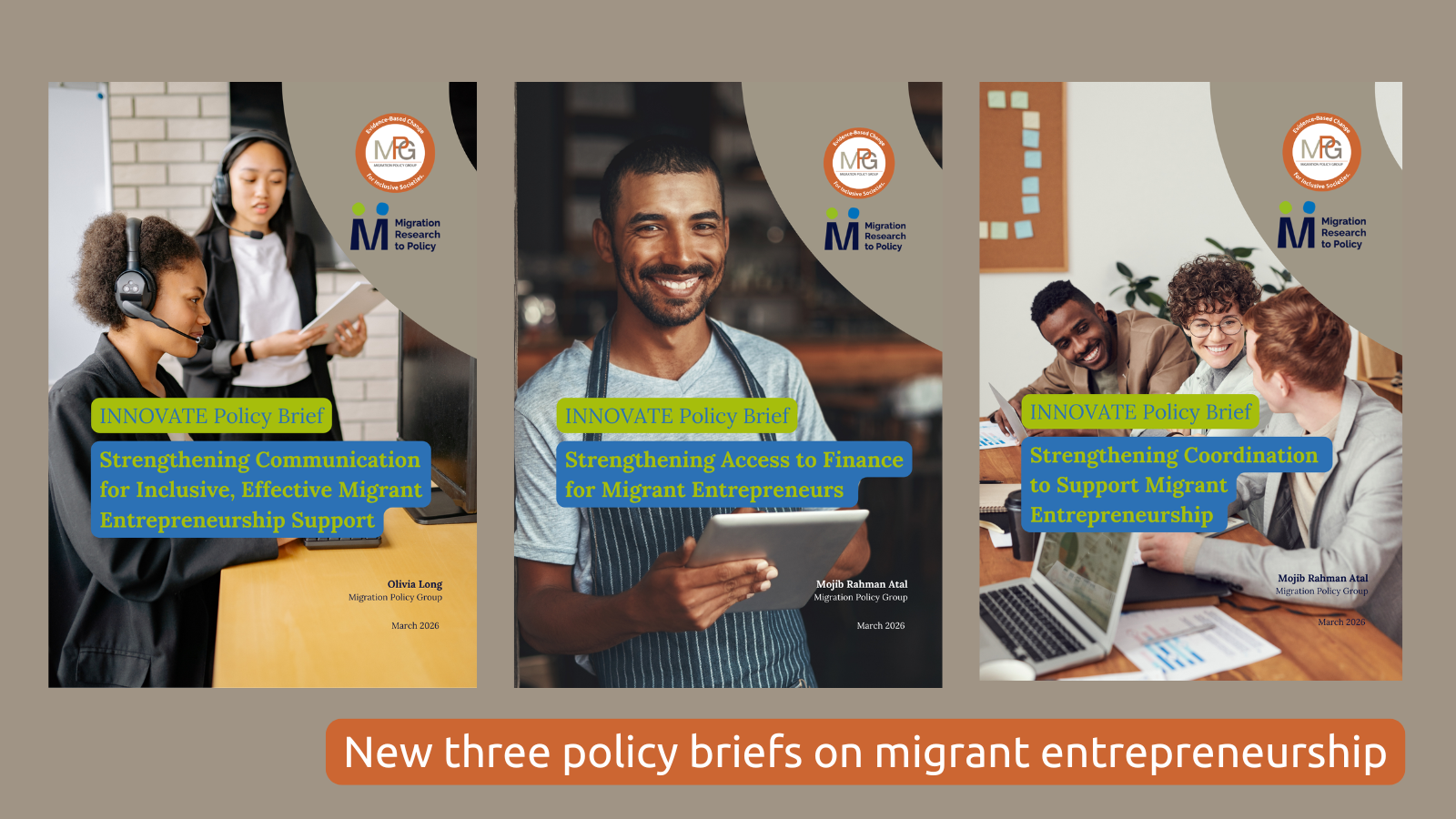
 The third brief addresses communication as a critical, yet often overlooked, component of migrant entrepreneurship support.
It finds that communication practices are frequently fragmented, insufficiently tailored, and not always aligned with the needs of diverse migrant communities.
Barriers include language limitations, digital exclusion, and inconsistent messaging across institutions. These challenges can reduce awareness of available services and limit their effectiveness.
The brief calls for:
- multilingual and culturally responsive communication strategies
- improved digital accessibility and inclusion
- greater use of peer-to-peer and community-based communication
- stronger coordination of outreach efforts
Embedding communication within policy design and service delivery is essential to improve access, trust, and engagement.
Towards more coherent and inclusive ecosystems
The three briefs highlight the interdependence of coordination, finance, and communication in shaping effective entrepreneurship ecosystems.
Addressing these areas in isolation is insufficient. Instead, policymakers should adopt integrated approaches that:
- align actions across sectors and levels of governance
- connect financial, institutional, and support services
- ensure that information is accessible and relevant to diverse users
Strengthening these systems is essential to unlocking the full potential of migrant entrepreneurship and maximising its contribution to inclusive economic development.


About the Migration Policy Group (MPG)
MPG is an independent think-and-do-tank based in Brussels. MPG’s purpose is rooted in its ability to inspire networks to provide evidence-based projects, research and campaigns in the areas of integration, migration and anti-discrimination.