Reflection paper: Inclusive policy elevates migrant women’s political voice, new research finds
Reflection paper:
Inclusive policy elevates migrant women’s political voice, new research finds
Dr. Başak Yavçan, Head of Research & Chiara Agrillo, Research Intern
Migration Policy Group, 26/06/2026
Data show that the same policies that strengthen migrants’ overall political participation also raise trust, efficacy and civic engagement among migrant women. Yet, most EU strategies still do not include such policy tools.
Political participation remains the weakest area of migrant integration policy across the EU. New research from Migration Policy Group (MPG)’s New Europeans Initiative shows that closing this gap matters as much for migrant women as for migrants overall, and that the policy tools to do it already exist.
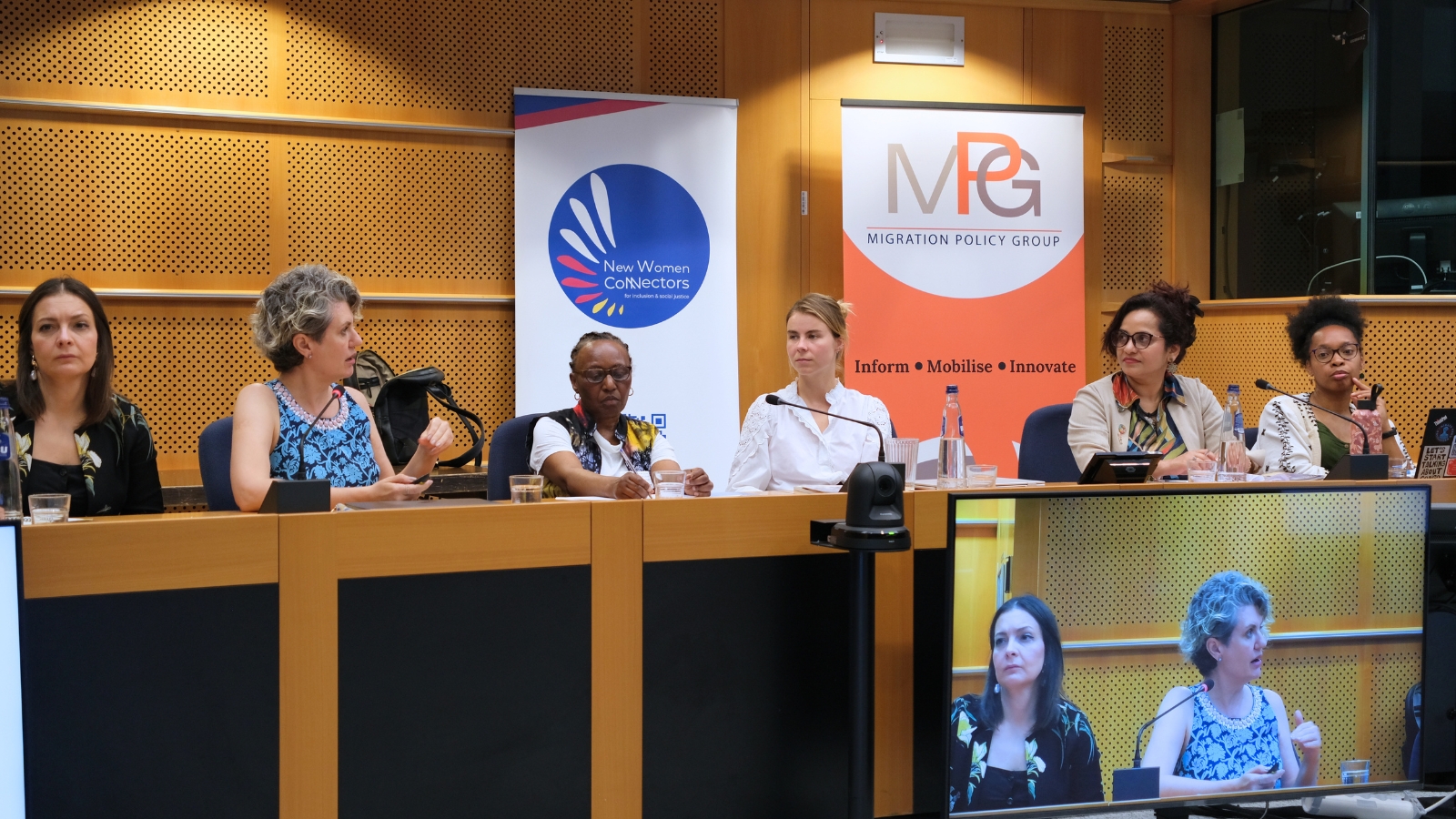
The findings, presented also to the European Parliament (EP) at an event on 23 June, are based on the Political Participation Policy Index and further MPG research which scores national frameworks across 22 EU countries on eight dimensions: national strategy, citizenship and voting rights, encouragement to vote, political and civil society representation, civic space and civic education. The index scores are built from standardised, expert-assessed indicators, drawing on national laws, official data and country experts, so that very different legal systems can be compared on a common scale. The index was then linked to administrative and survey data covering the same 22 countries in order to see how policy on paper translates into participation in practice, broken down by gender.
Building the index together with those most affected
The index was built though a participatory approach from the outset. An advisory council comprising of academic experts and migrant-led organisations helped define the indicators that truly matter. In addition, focus groups with migrant leaders from across the EU fed into the design their own experience of what barriers look like in practice and what measures are needed to enable participation. Crucially, both the advisory council and the focus groups included representatives of women migrant-led organisations who pushed for the gender dimension to be truly embedded in the indicators, rather than added an afterthought.
That gender lens shows up in three specific places in the Index, and the results are consistent: across the EU, the answer is almost always “no.”
The first is national strategy: when a country’s strategy lists groups of special concern for civic and political participation, alongside categories like asylum seekers, undocumented migrants and migrant youth, does it also list migrant women? In most EU states, it does not. The second is encouragement to vote: when a state calls for, or recommends that regional and local authorities undertake specific measures to boost voter turnout among groups of special concern, are migrant women named as one of those groups? Again, in most EU countries, they are not. The third concerns migrant-led civil society itself: when consultative bodies and advocacy platforms are required to be representative, are women and men represented in equal numbers? Across most of the 22 countries scored, no such requirement exists.
Germany stands out as the clear counter-example, scoring 43 on the index overall. It names migrant women and girls as a priority group in its national strategy, and frames their political and civic participation – and not only their labour-market integration – as an area that requires dedicated support. However, the fact that a single country can be cited as the exception across all three indicators is itself a measure of how wide this gap is.
A gap most strategies don’t see
Migrant women face barriers that compound: as migrants, and as women. The pattern that emerges from the index is less about hostile policy and more about invisibility. Strategies are rarely written to exclude migrant women on purpose; they simply don’t think to include them. Where gender is addressed at all, it tends to be in labour-market integration measures but not in the parts of a strategy concerned with political voice, civic space or representation.
What the data show
Linking the policy index to participation outcomes shows a consistent pattern. Countries with more inclusive political participation frameworks show higher institutional trust, political efficacy and civic engagement for both migrant women and men. Policies that actively encourage voting are associated with higher turnout. Support for migrant-led civil society and civic spaces, in addition, is associated with more non-electoral participation such as taking part in petitions, demonstrations and party activity.
Importantly, national policy choices appear to matter more for migrant women’s participation than gender alone. This means that introducing better policies will be an easy, immediate solution to the problem of limited women’s participation.
Priority recommendations
- Name migrant women explicitly in national strategies on political participation, with clear objectives and dedicated budgets.
- Run targeted campaigns to encourage voting among migrant women, delivered through local authorities and migrant-led organisations.
- Require equal representation of women and men in migrant-led consultative bodies.
- Fund migrant-led civil society on a stable, multi-year basis, and include organisations led by migrant women.
- Build leadership pathways, including mentoring and candidate training, for women with migrant backgrounds.
- Collect participation data disaggregated by gender and migration background, harmonised across EU countries.
These six points are part of the full set of eleven recommendation and are based on our research covering national strategy, citizenship, voting rights, civic education, civic space and data.
Why this matters now
The EP and the EU countries’ governments are currently shaping the next generation of integration and equality strategies. This research gives them a concrete, comparable evidence base: a way to see where their own country’s framework stands relative to their neighbours, and where it falls short, especially for migrant women.
As the gap is largely one of omission created by strategies that simply seem to forget migrant women, it is also straightforward to close. Rather than necessitating the involvement of more institutions and the creation of large new budgets, the strategies’ blind spots can be easily addressed through clearer policy drafting, targeted outreach and better data.
See our full Political Participation Policy Index (PPPI), as well as our further research From Policy to Practice: How Political Participation Frameworks Shape New Europeans’ Political Engagement with our full recommendations.
About the Migration Policy Group (MPG)
MPG is an independent think-and-do-tank based in Brussels. MPG’s purpose is rooted in its ability to inspire networks to provide evidence-based projects, research and campaigns in the areas of integration, migration and anti-discrimination.