MPG at IMISCOE 2026: Participatory methods take centre stage
Girona, Spain – Migration researchers have become increasingly sophisticated in studying participation. It is time, however, to be equally ambitious about practicing it.
This year’s annual conference of the International Migration Research Network (IMISCOE) was dedicated precisely to strengthening migration studies through community engagement. IMISCOE put participatory methods squarely at the centre of the conversation.
For us at Migration Policy Group (MPG), the conference offered a platform to show how participatory approaches can be more than just research methods: they can be a working practice, embedded across projects.
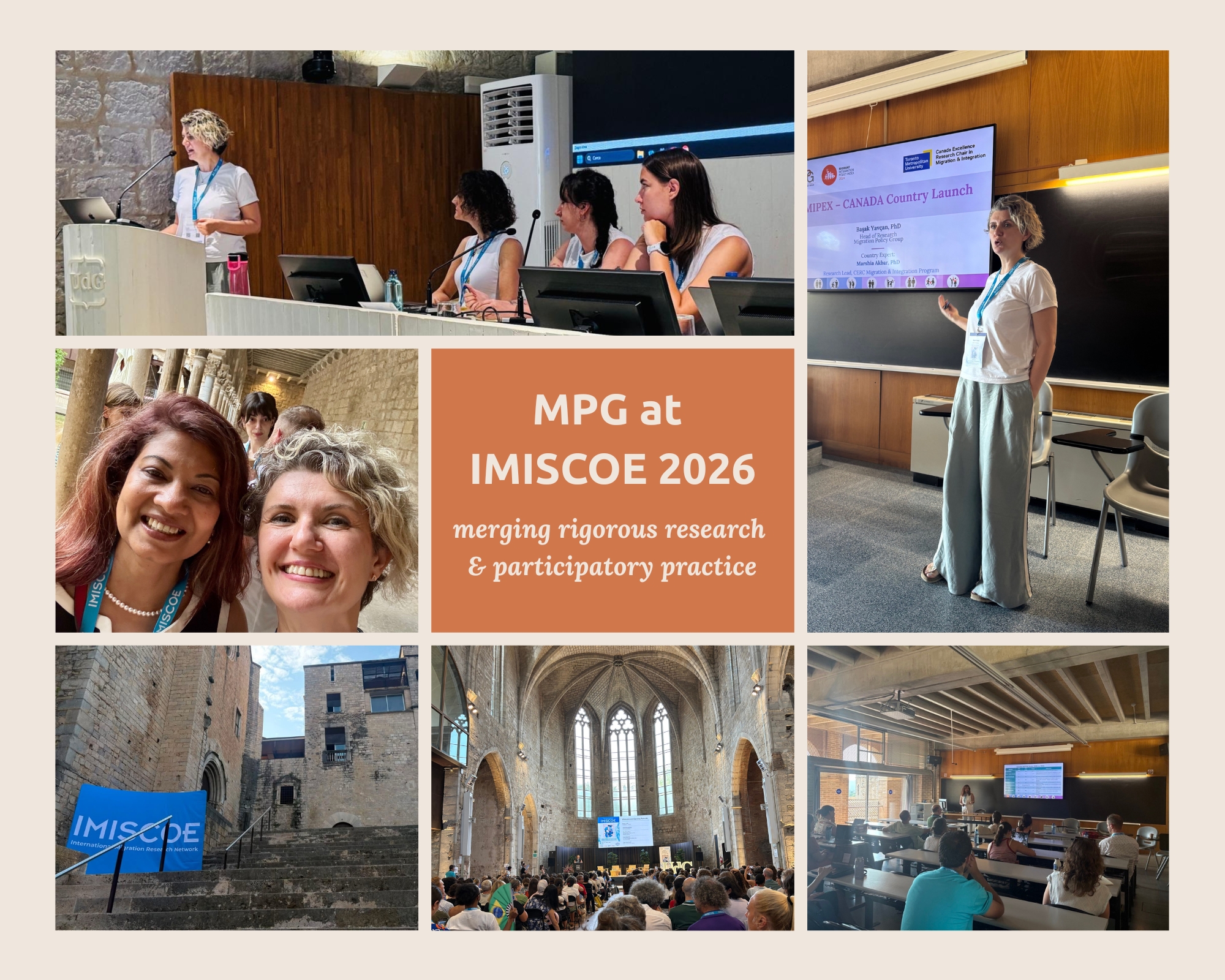
MPG Head of Research Dr Başak Yavçan took part in five sessions, including workshops and paper presentations. She also took on the role of a discussant, reflecting on how the issues of participation, belonging, and stakeholder engagement have become central to MPG’s research agenda.
Participation as practice, not just theory
The focus on how research can move beyond studying participation to actually enabling it made this year’s IMISCOE feel like a confirmation that migration research is changing.
Across the different sessions, one message kept emerging: the real impact of research is not measured by the number of citations alone. Instead, we should track the impact of our work by asking if it changes how institutions think, how policymakers act and how communities experience policy.
In a workshop on engaging left-behind communities, MPG presented the New Europeans Initiative’s Political Participation Policy Index (PPPI), a tool designed to help countries and cities self-assess and improve the engagement of migrants in local and national decision-making.
This work builds directly on MPG’s broader experience with policy labs and similar participatory practices. Instead of engaging stakeholders in one-off consultations after the findings of a project are already more or less finalised, participation is embedded in our processes from the get-go. This happens through structured spaces where stakeholders – including migrants themselves, civil society organisations and public authorities – are brought into a project from its earliest stages. Spaces where stakeholders’ needs are assessed and research is calibrated accordingly. The New Europeans Initiative is a case in point, as is the project INNOVATE in which MPG plays a central role in stakeholder dialogue. This illustrates how early-stage co-design can produce more relevant and legitimate research and policy outputs, closing the policy-research knowledge gap.
Crucially, MPG’s approach doesn’t stop at engagement for its own sake. We place equal emphasis on translating participatory processes into outputs that stakeholders and policymakers can actually use. These include trainings that build capacity within institutions, policy indices, and self-assessment toolkits that give practitioners concrete instruments to diagnose, advocate and improve policies and their subsequent implementation.
Beyond the participation-focused sessions, MPG also presented at IMISCOE the methodological work central to its index-based research. A paper presentation examined the gap between policy design and lived outcomes in Canada. The research uses the Migrant Integration Policy Index (MIPEX) framework, further developed with our MIPEX Canada Country Expert Marshia Akbar. Another paper laid out the methodology behind the Migration Return Policy Index (MIREX), highlighting the persistent gaps in fairness, legitimacy, and stakeholder involvement in return policies across EU+ countries, as well as dimensional analysis. Then, another contribution examined educational initiatives run by migrant organisations, drawing on the SIRIUS project and limited involvement of migrant groups in education policy. Finally, a discussant role in a panel on intersectional approaches to belonging rounded up MPG’s engagement with the conference’s core themes.
The throughline
The conversations in Girona confirmed that participatory approaches are becoming a defining feature of migration research. For MPG, they also reaffirmed the principle that has guided our work for many years: evidence has the greatest impact when it is produced with stakeholders, not simply for them. MPG’s contributions to this year’s IMISCOE reflect a similar institutional position: that rigorous, comparative research and genuine participatory practice are not in tension, but actually reinforce one another.
As migration studies continues to grapple with how to meaningfully include the communities they studies, MPG’s experience from convening policy labs to creating indices (such as MIPEX and SIRIUS) and toolkits (such as the Whole Comm Local Integration Tool Box) offers a concrete example of what this can look like in practice.
We were happy to engage with the IMISCOE network, share our tools and practices and find new inspiration. We also hope to see more outputs produced with better participatory methods, be it with migrant communities, members of the host societies, advocacy groups, NGOs, municipalities, national or international policy makers.
About the Migration Policy Group (MPG)
MPG is an independent think-and-do-tank based in Brussels. MPG’s purpose is rooted in its ability to inspire networks to provide evidence-based projects, research and campaigns in the areas of integration, migration and anti-discrimination.